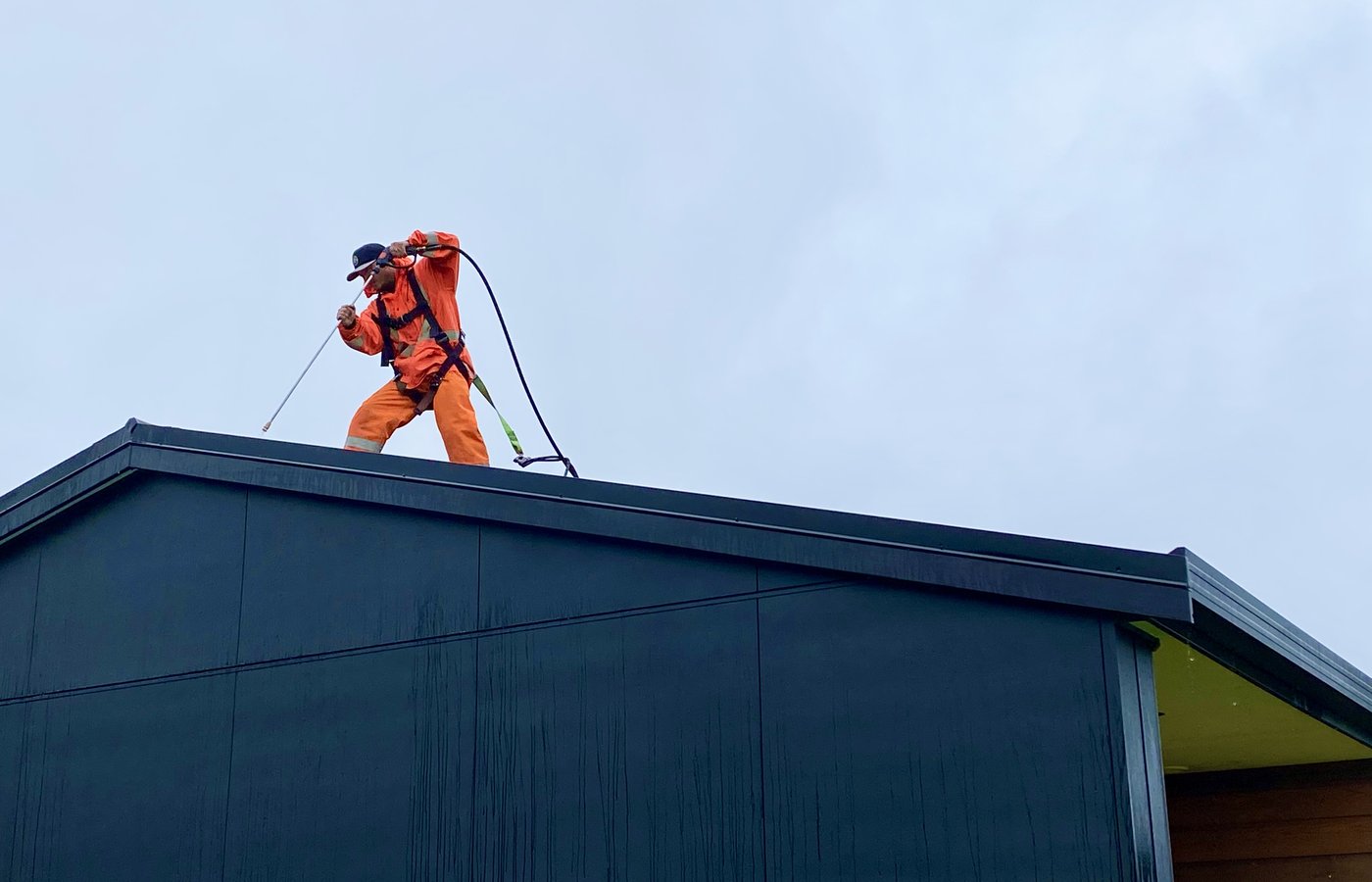
Blast Away Guys provides residential and commercial roof cleaning across Whangārei, Northland and the Bay of Islands. We have cleaned 11,237+ properties, from family homes and small sheds to commercial roofs the size of 12 rugby fields.
We offer two roof-cleaning methods. A professional roof treatment kills moss, mould and lichen, then lets the sun and rain gradually clear the dead growth. A roof wash removes visible growth during the visit and is better when an immediate result is needed or the roof is being prepared for painting.
For routine maintenance, most dirty roofs do not need to be washed. Treatment is often the gentler and more affordable option. It uses far less water and avoids unnecessary washing of the roofing surface.
For Auckland homes and commercial properties, visit our Auckland roof cleaning page.
Where washing is needed, we use soft washing methods to clean the roof gently without unnecessary high pressure.
Best for routine roof cleaning, preventative care and customers who can wait for gradual results
Growth dies and clears gradually with the sun and rain
Improvement often becomes visible within 2 to 3 months, but complete clearing can take much longer
Uses much less water than a roof wash
Usually the more affordable option
The treatment remains on the roof and continues working
Best for painting preparation, pre-sale presentation or anyone needing an immediate visual result
Visible growth and grime are removed during the visit
The visual improvement is immediate
Uses considerably more water than a roof treatment
Usually more expensive because it takes more labour, time and equipment
We apply an included follow-up treatment after washing to help deal with remaining spores and slow regrowth
A roof treatment is applied to the roofing surface to kill moss, mould and lichen. It is not rinsed off. Sunlight and rain gradually break down and remove the dead growth.
Moss, mould and lichen can behave like a wet towel left across your roof. They hold moisture against the surface after the rain has stopped. Over time, this can stain or damage protective coatings and roofing materials.
You will often notice moss and lichen changing colour within the first 2 to 3 months. Moss and lichen can take up to 12 months to clear. Heavy black mould can take up to 18 months. Every roof responds differently
A single treatment is generally suitable for a roof with light moss, mould or lichen.
Heavy lichen, black mould or more established growth usually needs a dual treatment. This means the roof, or the heavily affected parts of it, receives a second application during the same visit.
If a roof has extremely heavy lichen or black mould, we may also recommend a gel treatment during the same visit. The gel remains on heavily affected areas for longer.
Not every part of a roof is affected equally. The main roof surface may have light growth while the ridges have heavy lichen. In that situation, the lightly affected areas may need one application while the ridges receive two.
Our technicians inspect the roof before beginning. If its condition is different from what was expected when the quote was prepared, we will discuss the recommended treatment with you before proceeding
No. The product used is only one part of a successful roof treatment.
The result also depends on:
A strong concentrate can still produce a weak working mixture if too much water is added. Heavy black mould and established lichen also need a different approach from light growth.
A safety data sheet may show that a product contains 50% benzalkonium chloride raw material. That does not necessarily mean the finished concentrate is 50% active.
If half the finished product is made from a raw ingredient that is itself 50% active, the finished concentrate contains 25% active ingredient.
It is similar to making a drink with cordial that has already been diluted. Knowing how much cordial was poured into the container does not tell you its original strength.
We asked our supplier a more specific question: what percentage of active ingredient is in the finished, undiluted product?
Our newly sourced professional concentrate has been confirmed in writing by the supplier as containing 50% active ingredient in the finished product. That is approximately twice the active concentration of the commercial product we have normally used.
This gives us another option for roofs heavily affected by thick black mould or established lichen. It does not mean every roof should receive the strongest possible mixture. We still choose the product, working strength and number of applications for the growth and roof in front of us.
We usually recommend a roof wash when:
The roof is being prepared for painting
The property is going on the market soon and needs an immediate visual improvement
The customer does not want to wait for a roof treatment to work gradually
Heavy black mould or lichen needs to be removed immediately
The washing method depends on the roofing material, pitch, age and condition. After the roof has been washed, we apply an included follow-up treatment. Washing removes visible growth. The treatment helps deal with remaining spores and slows regrowth
There is no single timeframe that applies to every roof. Regrowth depends on the environment surrounding the property.
A roof may need attention more often if it:
Is shaded by trees or nearby buildings
Has a south-facing area that receives less sun
Has a low pitch and stays damp for longer
Collects leaves, pollen, bird droppings or residue from nearby trees
Is made from a porous or textured roofing material
Is exposed to coastal salt or airborne pollution
Some roofs need a treatment every year or two. Others may remain clear for three years or longer. We can recommend a maintenance interval after seeing the roof and its surroundings
Mould produces microscopic spores that travel through the air. These spores can settle on other damp or shaded surfaces around the property.
If the house roof has mould or lichen, it is sensible to check nearby garages, sleepouts, sheds and other buildings. Airborne spores may already have settled on those roof surfaces.
We also regularly see mould and lichen on the roofs of caravans, campervans and motorhomes parked near affected buildings. These roofs are worth checking when the permanent buildings on the property are assessed
If your roof supplies a drinking-water tank, the downpipes must be disconnected before treatment. They must remain disconnected until the roof has received at least 30 mm of rainfall.
If you need help disconnecting the tank, please tell us before the visit. Where disconnection is not practical, we can quote to install a manual downpipe diverter
The safest approach depends on the roofing material and its condition. We generally recommend treatment instead of washing for clay, slate and concrete tiles. Tiles may be loose or brittle. Pressed-metal tiles can also dent if walked on incorrectly.
Long-run metal, Colorsteel and painted roofs are assessed for age, coating condition, corrosion and fixings before work begins. Older or fragile clear roofing can hold staining within the material, so a perfect result is not always possible
Roof cleaning involves working at height and on surfaces that may be slippery. Our technicians use the access and fall-protection equipment required for the roof and site. Blast Away Guys has held SiteWise safety accreditation for seven years, including five consecutive years at Gold level
The price depends on the roof area, pitch, height, access, roofing material and amount of growth. A roof wash costs more than a treatment because it normally requires more time, water, labour and safety equipment.
Send us the property address and clear photographs if you have them. We will recommend the option that suits the roof and your end goal
Blast Away Guys has cleaned 11,237+ properties across Northland and Auckland. Our work ranges from family homes and sheds to schools and very large commercial buildings. We provide clear advice before work begins and realistic expectations about how long a treatment may take
One commercial property owner had been paying $7,217 each year to have a large roof washed. We showed the owner examples of other large and small commercial roofs we had maintained with treatment rather than repeated washing.
Treating that roof cost $2,362.81.
That was a saving of $4,854.19 in one year.
It also used much less water and placed less strain on the roofing surface. We do not recommend treatment simply because it is cheaper.
We recommend it because, for routine maintenance, it is often the gentler and more practical option.
A roof wash still has an important place when a customer needs an immediate visual result or the roof is being prepared for painting. The end goal should decide the method, not the assumption that every dirty roof needs washing.
Request a quote and tell us whether you want a gradual, cost-effective treatment or an immediate roof wash. If you are unsure, send us the address and photographs. We will help you choose
Heavy lichen, black mould or more established growth will usually need a dual treatment. This means the whole roof, or the heavily affected areas, receives a second application during the same visit.
For extremely heavy growth, we may also recommend a gel treatment that remains on the affected areas for longer.
We assess the roof before starting and confirm the recommended treatment with you. The cost depends on how much of the roof needs the additional treatment.
There is no fixed timeframe. Regrowth depends on shade, nearby trees, airflow, roof pitch, roofing material and local conditions. After washing a suitable roof, we apply a follow-up treatment to help deal with remaining biological growth and slow its return. Some roofs need attention every year or two, while others may remain clear for three years or longer. We can recommend a maintenance interval after assessing the roof and its surroundings.
A wash removes the visible growth, but it doesn’t kill the spores buried deeper in the surface. That’s why we always apply a follow-up roof treatment after every wash. This helps prevent moss and mould from coming back quickly and gives you longer-lasting results from your investment.
The risk depends on the roofing material, age, condition and washing method. We assess the roof before recommending washing. Where washing is suitable, we adjust the equipment, pressure and nozzles for the surface. We generally recommend treatment rather than washing for clay, slate and concrete tiles because they may be loose, brittle or vulnerable to damage. If a roof is fragile or unsuitable for washing, we will explain the safer options.
A roof wash gives you instant results. It removes visible moss, mould, grime, and lichen right away using a soft wash system. A roof treatment, on the other hand, is sprayed on and works gradually with the sun and rain over time. The roof wash delivers a dramatic visual improvement on the day, while the follow-up treatment we include helps prevent regrowth.
Yes. If you're selling your home, we can provide a Completion of Works Certificate confirming the treatment has been applied. It’s a great document to pass on to your real estate agent or potential buyers for peace of mind.
We assess the roofing material, its condition and the surrounding areas before choosing how to treat it. Our technicians apply the treatment carefully and take reasonable steps to protect gardens and nearby surfaces. If the roof supplies a drinking-water tank, the downpipes must remain disconnected until the roof has received at least 30 mm of rainfall. Please tell us about tanks, sensitive plants or fragile roofing materials before the visit.
We apply a treatment that targets moss, mould and lichen. It is left on the roof rather than rinsed away. The growth dies first, then sunlight, rain and weather gradually loosen and clear it. This can avoid the need for immediate washing on many roofs, although the right method still depends on the roofing material and its condition. The clearing time varies with the type and thickness of the growth.
Exterior cleaning can be completed throughout most of the year. The best timing depends on the service, the surface and the weather. We avoid conditions that could make the work unsafe or reduce the effectiveness of a treatment, such as heavy rain or strong wind. If the weather affects your booking, we will contact you and arrange another suitable time.
It depends on the roof’s pitch, height, condition and access. Where it is safe and appropriate, our trained technicians use suitable fall-protection equipment. Some roofs require scaffolding or an elevated work platform. We assess the access requirements before the work and explain any additional equipment in your quote.
As a general rule, we don’t recommend water blasting tiles as they are often loose and water blasting can blow them off the roof which breaks them. The gentlest and cheapest option to get your roof clean is a roof treatment. If for some reason you really need to wash we will come and take a look at it and assess whether or not it is an ok candidate for a wash
If you are on tank water you will need to disconnect the tanks prior to us arriving. They will need to stay disconnected until there has been 30 mm of rainfall. If you need help disconnecting the tanks please let us know.
The treatment product we use is 100% water-soluble. This means that the rain will wash it away even on a porous surface. To be really safe we recommend that water tanks stay disconnected until there has been 30 mm of rainfall.
A roof wash is usually the better option when the roof is being prepared for painting or you need an immediate visual improvement, such as before selling.
For routine maintenance, treatment is usually our first choice. Heavy black mould or established lichen does not automatically mean the roof needs washing. We may recommend a dual treatment, with a second application during the same visit, or a gel treatment for extremely heavy growth.
We assess the roofing material, condition, growth and your timeframe before recommending the right method. Where washing is suitable, we include a follow-up treatment to help slow regrowth.
A roof treatment involves spraying a product onto the roof surface which kills lichen, moss and mould. The product we use works by killing off the growth and spores and then the rain and sun gradually break down and remove the dead lichen, moss and mould. This process can take up to 12 months or in some cases where there is a thick covering of black mould up to 18 months. Generally, results can usually be seen in the first 2 to 3 months with the moss and lichen changing colour.
Some roofs will remain free of growth for up to 3 or four years and others will need to have an annual or biannual treatment it just depends on the roofing material and the environmental factors that surround the roof. For example, if there are large trees nearby this can cause moss and mould to grow more quickly. Commercial roofs generally need treating every year as they often do not have much of a pitch and so moulds and lichens tend to attach its self and grow better.
Choose house washing, roof treatments, bug treatments, chimney sweeping and more, all in one coordinated visit. Ask us to price the services separately and together so you can compare the options.


